
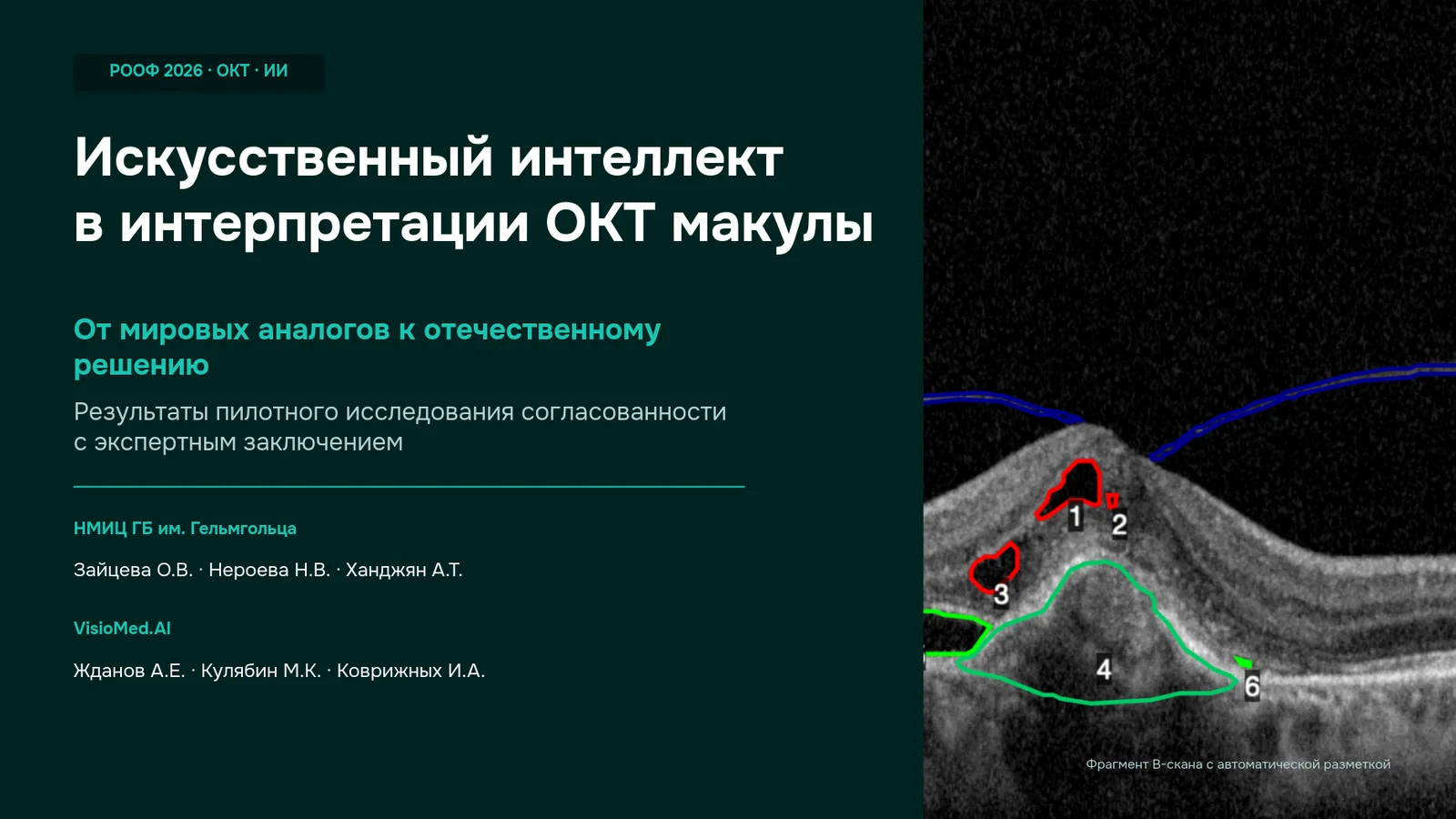
At the XIX Russian National Ophthalmological Forum (ROOF 2026, Moscow, September 23–25), O. V. Zaytseva of the Helmholtz National Medical Research Center of Eye Diseases presented a joint talk with VisioMed.AI, “Artificial intelligence in macular OCT interpretation”. Authors: O. V. Zaytseva, A. T. Khandzhyan, N. V. Neroeva (Helmholtz Center), I. A. Kovrizhnyh, M. K. Kulyabin, A. E. Zhdanov (VisioMed.AI).
The talk reviewed AI systems for OCT analysis in Russia and abroad. All of them detect biomarkers and return a list of likely diagnoses, but none produces a full structured description of the scan. That is what our module does: a description of each biomarker with its measurements, their clinical interpretation, and a conclusion with a suggested diagnosis and ICD-10 code, ready for a physician to verify.
At its core are two independent neural analyses of the same scan. The segmentation model finds 16 biomarkers and measures their area, size and number of lesions. The classification model assigns the scan to 14 classes (13 diseases and conditions plus normal), and one scan can match several classes at once. A clinical weight matrix brings the two together: each biomarker either supports a diagnosis or counts against it, while the classifier adds at most four points and cannot make a diagnosis on its own. For a full-thickness macular hole, morphometry and standardized indices are calculated automatically.
In a pilot study, automated reports for 108 de-identified OCT scans were each assessed independently by two Helmholtz Center experts with at least ten years of OCT experience. Full agreement with the expert interpretation was reached in 75.9% of cases (82 of 108), full or partial agreement in 93.5% (101 of 108). Partial meant the leading pathology was right but secondary biomarkers were described incompletely. These are pilot data; the results are being prepared for publication.
Next come more biomarkers and conditions, segmentation of retinal layers, a unified OCT reporting protocol, and assessment of indications for anti-VEGF therapy. Automated interpretation remains a supporting tool: the decision always rests with the physician.
органзрения.рф